
Serving the Gainesville and Hawthorne Florida Area


ENGINE OVERHAULS OR REPLACEMENT: $2000 TO $10000 (Parts and labor)
(Prices good for most domestic or import cars and light trucks)
Return to the Econofix Home Page
Engines or Motors: Repair, Overhaul, and Diagnosis
HOW ENGINES WORK
Even though an engine is more complicated recently with computer controls and such, all internal combustion piston engines basically work the same way. Almost every car and truck engine is a four cycle piston engine, commonly known as a four stroke engine.
There are other types of engines: the Wankel is a rotary engine that Mazda still uses in the "RX" series, big truck diesels are often a two stroke piston engine (diesel), and SAAB once made a car with a two stroke gas engine. This article is just about four stroke engines.
A internal combustion piston engine burns a fuel and air mixture inside a cylinder. A piston inside this cylinder is forced to the bottom of the cylinder by the pressure of the burning fuel. The piston is attached to a connecting rod, which turns a crankshaft.
What is a Stroke? A Cycle?
A "stroke" is when the piston travels from one end of the cylinder to the other.
When the piston goes from the top of the cylinder to the bottom it is said to be "on the down stroke".
When it travels from the bottom of the cylinder to the top it is said to be "on the up stroke".
THE STROKES
A four cycle engine has four strokes: the intake stroke, compression stroke, power stroke, and the exhaust stroke, then repeat the cycle. The crankshaft rotates two times to complete the four strokes, two upstrokes and two downstrokes.
THE INTAKE STROKE
On the intake stroke the piston is on a down stroke. The intake valve is open. In a gas engine the piston draws in a fuel and air mixture to burn. On a diesel engine just air is drawn in: the fuel is injected directly in to the cylinder later.
THE COMPRESSION STROKE
The compression stroke is next: it is an upstroke. During the contents of the cylinder are compressed, creating pressures of 150 pounds or more on a gas engine or 300 pounds or more on a diesel engine. Under this pressure the cylinder contents ignite easily and burn almost completely.
THE POWER STROKE
The power stroke is a down stroke. The burning fuel forces the piston down and turns the crankshaft.
The compressed fuel air mix is ignited by a spark plug in a gas engine. A diesel is a "compression ignition" motor: It has injectors which spray fuel directly into the cylinder. Because of the highly compressed air and heat in the cylinder, the fuel spontaneously ignites without the need for a spark plug.
THE EXHAUST STROKE
The exhaust stroke is an up stroke. The exhaust valve opens and the piston moves to the top, forcing the burned exhaust gasses out of the cylinder.
VALVES AND CAMSHAFTS
The valves are opened by a camshaft. It has eccentric "lobes" which press against "valve lifters" which open the valves.
CYLINDER BLOCK AND CYLINDER HEAD
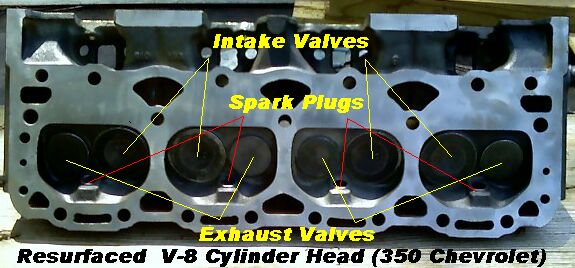
There are 2 major parts to your engine: the block and the head. The block contains the pistons and crankshaft. The head contains the valves. The camshaft can be either in the block or the head. If the cam is in the head, it is called an OVERHEAD CAM ENGINE. All four stroke engines have at least two valves per cylinder: an intake valve and an exhaust valve. Many engines now have 3 or more valves per cylinder, with 4 valves being common. With 3 valves they use 1 exhaust and 2 intakes. With 4 they use 2 intakes and 2 exhausts. This is done to increase flow through the valves of the fuel air mix and increase the power and efficiency of the engine. The downside is that it makes them more expensive to repair!
Here's a picture of a 350 CID Chevrolet cylinder head
MANIFOLDS
An intake manifold connects to the head and admits the fuel air mix, and the exhaust manifold connects to the vehicle's exhaust system. There will be one "port" (tech for "hole") in each manifold for each cylinder.
What it takes for an engine to run properly
In order for an engine to run properly the valves must open and close at exactly the right time. This is called VALVE TIMING
A proper fuel/air mixture must be in the cylinder. Engine timing is expressed in degrees of crankshaft rotation. When the piston is at the top of its upstroke, it is said to be " AT TOP DEAD CENTER (TDC)" or 'AT ZERO DEGREES". Most all gas engines fire their spark plugs before top dead center, so timing specs often say things like "4 degrees BTDC", or Before Top Dead Center
When the piston is at the bottom of the downstroke it is at "BOTTOM DEAD CENTER" or 180 degrees.
On a gas engine IGNITION TIMING is the time the spark plugs fire relative to the position of the piston, or crankshaft.
Diesel engines don't have spark plugs, but they have INJECTION TIMING: the fuel must be injected into the cylinder at the right time or a diesel won't run!
VALVE TIMING is the time the valves open relative to the piston, or crankshaft.
Here's some images of Car Engines
Auto, Car, and Truck Article List
A
ABS: Anti-Lock Brake Systems
ADVANCE: Car ignition timing
ALTERNATORS and Car Battery
AUTOMATIC TRANSMISSIONS
B
BAD CAR DESIGNS
Bad Drivers: How NOT to drive
BATTERIES: Auto, Car or Truck
BELTS AND HOSES
BEARINGS
BODY AND BUMPER REPAIRS
BRAKE REPAIRS: Car or Truck
C
Car Washing and Care
CARBURETORS:Car & Truck
CHECK ENGINE LIGHT
CLEANING: Engine Cleaning
CLUTCH REPAIRS: Car & Truck
COIL (IGNITION)
COMPRESSION: Car Engine
COMPUTER CAR CONTROLS
CV JOINT OR CV AXLES
D
DISTRIBUTORS (IGNITION)
E
ELECTRIC WIRING REPAIR
ENGINES: Car & Truck
ENGINE CLEANING
EXPANSION PLUGS
F
FILTERS: OIL, AIR, ETC.
FREEZE PLUGS
FUEL AIR MIXTURE
FUEL INJECTION: Car & Truck
FUEL PUMPS: Car & Truck
G
GAGES AND "IDIOT LIGHTS"
GASKETS AND SEALS
GLASS: WINDOWS AND WINDSHIELDS
H
HEADS & HEAD GASKET
HOSES AND BELTS
I
"IDIOT LIGHTS" AND GAGES
IGNITION COIL
IGNITION TIMING: Car & Truck
J
AUTO JACKS: lifting cars safely
K
L
LEAN "Car runs lean"
LIGHTS: WARNING OR "IDIOT LIGHTS"
Limp Home Mode
M
MIL Light
MANUAL TRANSMISSIONS
N
NO START: Car Won't Start
O
OIL CHANGES
OIL: What's right for your car?
OIL LIGHT ON OR GAGE LOW
P
PCV Valve
Q
R
RADIATORS: Car and Truck
RICH: Car runs rich
S
SEALS AND GASKETS
SERVICE ENGINE SOON LIGHT
SPARK PLUGS
STARTERS: Auto, Truck
T
THERMOSTATS
TIMING: IGNITION TIMING
TIMING BELT & TIMING CHAIN
TIRE REPAIR
TRANSMISSIONS: AUTOMATIC
TRANSMISSIONS: MANUAL
U
V
VACUUM ADVANCE
WARNING LIGHTS OR "IDIOT LIGHTS"
Car Washing and Care
W
WATER PUMP REPAIR
WINDOWS AND WINDSHIELDS
WIRING REPAIR
X
Y
Z
RETURN TO THE ECONOMECHANIX HOME PAGE
Thank you for visiting the ECONOMECHANIX WEB SITE. Please feel free to comment.
>> CLICK HERE: The Econofix Cyber Mall!!! >