
Serving the Gainesville and Hawthorne Florida Area
Auto, Car, Truck Repair Advice


Freeze plug replacement: $60 up
(Prices good for most cars and light trucks)
Return to the Econofix Home Page
Serving the Gainesville and Hawthorne Florida Area
Freeze plug replacement: $60 up
(Prices good for most cars and light trucks)
Freeze plugs are also called frost plugs, engine block expansion plugs, core plugs, or Welch plugs
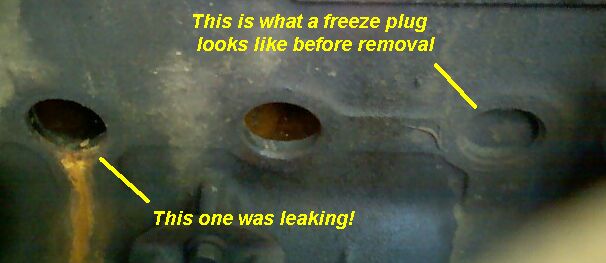
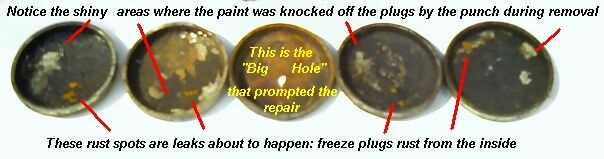
So if you have water leaking down the side of your engine, or water leaking from the hole in the bell housing between the engine and transmission, you probably have a bad freeze plug. Sometimes the hole in the freeze plug is very small, and can periodically stop when a piece of crud from the cooling system jams in the hole.
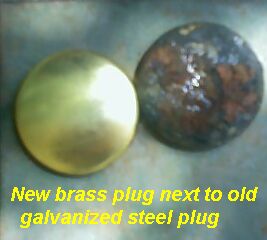
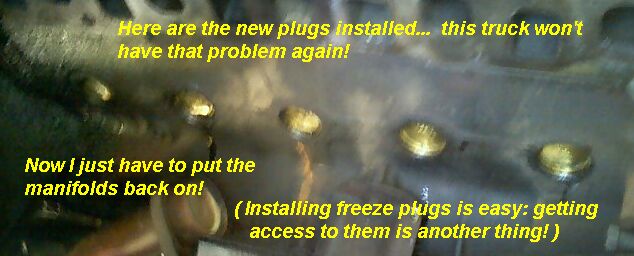
When I replace freeze plugs or rebuild an engine I always use brass plugs: they only cost a tiny bit more and will not rust through. The manufacturers don't use brass plugs of course: they cost a few cents more, and they will save a penny anywhere they can: pennies add up to millions of dollars!
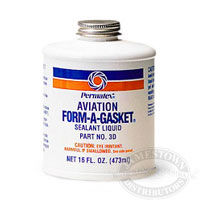
Normal freeze plugs are hammered in with some sealant around them. I use aviation grade Permatex sealer.
A special tool is made to install freeze plugs: the tool is available at a good auto parts store. In a pinch you can use a large socket that just barely fits inside the rim of the plug, however this can damage the new plug if you aren't careful.
If you can't get to the freeze plug to hammer it in, you have to take off whatever parts are in the way to access the plug. Sometimes it's easier to remove the engine from the car. Another option when access is limited is an expanding replacement freeze plug. These replacement plugs are made of either copper or rubber. A nut on them expands the plug against the block when tightened. These plugs can be installed in areas too tight to hammer in a regular freeze plug. I have had bad luck with the rubber type: they blow back out quite often. I have had good results with the copper type (made by Dorman).
I have not had good results with either type on Ford products: Ford for some reason makes their freeze plugs in "odd" dimensions, like 1 and 51/64 of an inch. You can get the copper type plug in 1/8 th increments, but it won't expand enough to fit the Ford size. The rubber type will SEEM to expand enough, but it will stay in for a week or so then blow out, dumping all your coolant out in a matter of seconds!!!
So on all Fords I just do whatever it takes to pound a regular style brass plug into the block.
The hard part is taking the exhaust and intake manifolds off: after that the job is easy.

There have to be "cylinders" made of sand in the middle of this mold to create the cylinders of the engine block. These chunks of sand can't just "float" inside the mold: SOMETHING has to hold them in place. There are little columns of sand that connect the cylinder mold to the outer mold half. The mold for the cylinder "sits" on top of these. After the block is cast, these holes are machined smooth and a "freeze plug" or "expansion plug" or "core plug" is put in to plug the hole.
Here's a video of a mechanic replacing some freeze plugs
CAUTION! I have one issue with this freeze plug video: He uses no sealant on the new freeze plugs, and he's not using brass freeze plugs.
I always use aviation grade permatex sealant on freeze plugs. It's available at any good auto parts store.Don't use RTV silicone: I've seen freeze plugs "pop out" with silicon seal.
Freeze plugs will work when put in "dry", but they might "weep" a small amount of coolant.

A
ABS: Anti-Lock Brake Systems
ADVANCE: Car ignition timing
ALTERNATORS and Car Battery
AUTOMATIC TRANSMISSIONS
B
BAD CAR DESIGNS
Bad Drivers: How NOT to drive
BATTERIES: Auto, Car or Truck
BELTS AND HOSES
BEARINGS
BODY AND BUMPER REPAIRS
BRAKE REPAIRS: Car or Truck
C
Car Washing and Care
CARBURETORS:Car & Truck
CHECK ENGINE LIGHT
CLEANING: Engine Cleaning
CLUTCH REPAIRS: Car & Truck
COMPRESSION: Car Engine
COMPUTER CAR CONTROLS
CV JOINT OR CV AXLES
D
DISTRIBUTORS (IGNITION)
E
ELECTRIC WIRING REPAIR
ENGINES: Car & Truck
ENGINE CLEANING
EXPANSION PLUGS
F
FILTERS: OIL, AIR, ETC.
FREEZE PLUGS
FUEL AIR MIXTURE
FUEL INJECTION: Car & Truck
FUEL PUMPS: Car & Truck
G
GAGES AND "IDIOT LIGHTS"
GASKETS AND SEALS
GLASS: WINDOWS AND WINDSHIELDS
H
HEADS & HEAD GASKET
HOSES AND BELTS
I
"IDIOT LIGHTS" AND GAGES
IGNITION TIMING: Car & Truck
J
AUTO JACKS: lifting cars safely
K
L
LEAN "Car runs lean"
LIGHTS: WARNING OR "IDIOT LIGHTS"
Limp Home Mode
M
MIL Light
MANUAL TRANSMISSIONS
N
NO START: Car Won't Start
O
OIL CHANGES
OIL: What's right for your car?
OIL LIGHT ON OR GAGE LOW
P
PCV Valve
Q
R
RADIATORS: Car and Truck
RICH: Car runs rich
S
SEALS AND GASKETS
SERVICE ENGINE SOON LIGHT
SPARK PLUGS
STARTERS: Auto, Truck
T
THERMOSTATS
TIMING: IGNITION TIMING
TIMING BELT & TIMING CHAIN
TIRE REPAIR
TRANSMISSIONS: AUTOMATIC
TRANSMISSIONS: MANUAL
U
V
VACUUM ADVANCE
WARNING LIGHTS OR "IDIOT LIGHTS"
Car Washing and Care
W
WATER PUMP REPAIR
WINDOWS AND WINDSHIELDS
WIRING REPAIR
X
Y
Z
RETURN TO THE ECONOMECHANIX HOME PAGE
Thank you for visiting the ECONOMECHANIX WEB SITE. Please feel free to comment.